
Hennepin 72-Hour Release Source
The Hennepin County jail roster is the official starting point. It contains a “Released from Custody” option, a Released Date control, and a Released Date/Time on the detail record. There is no separate Sheriff URL labeled “72-hour release list.” The three-day view is therefore made by selecting released records and keeping only timestamps within the preceding 72 elapsed hours.
This method differs from choosing three named dates. If the check is made late in the afternoon, part of the first calendar date falls outside the true window. Record the cutoff time before reading results. A three-day date range may be used to collect candidates, but the detail timestamp decides whether each booking belongs in the interval.
Check Hennepin 72-Hour Releases
A wider date range can return more names and more repeat bookings. Confirm identity before recording an event. The booking number is the strongest local identifier, while age, received time, agencies, and charge details provide useful cross-checks. An official booking photo may also appear, but appearance alone should never decide a match.
- Write down the exact current date and time, then calculate the 72-hour cutoff.
- Open the official roster and choose Released from Custody.
- Set Released Date broadly enough to span each calendar date touched by the interval.
- Open the detail for each possible match and compare Released Date/Time with the cutoff.
- Confirm the booking through booking number, name, age, received time, and agency fields.
- Resolve the legal basis and any destination with the court record or an HCSO data request.
For a release confined to the most recent day, the 24-Hour Release List provides the narrower method. For a named person whose possible custody spans county, state, federal, or immigration systems, use the full Hennepin County release search path.
Hennepin Three-Day Release Fields
The roster can show the fields below, although not every booking contains every item. Separate custody facts from case facts. A charge description or scheduled court date does not establish how the booking ended, and a Released Date/Time does not by itself prove a return to the community.
| Roster field | Use in a 72-hour review |
|---|---|
| Custody Status | Confirms that the selected view concerns records marked released from HCSO custody. |
| Booking Number | Links the event to one booking and helps distinguish repeat contacts. |
| Name and Age | Helps separate people with similar names. |
| Received Date/Time | Shows the start of the recorded county custody interval. |
| Released Date/Time | Determines whether the record falls within the rolling three-day cutoff. |
| Arresting/Charging Agency | Identifies agencies connected with the booking and charges. |
| Charge Data | Can include description, severity, statute, and status. |
| Photo | May show the official booking image attached to the record. |
If the roster does not show release reason or destination, ask for those existing fields. Minnesota Statutes § 13.82, subdivision 2 makes the date, time, and legal basis of release public arrest data. It also covers the date, time, legal basis, and recipient for a transfer.
A three-day review often includes several records for one name. Treat each booking as a separate event. Received Date/Time can reveal whether a result belongs to an older booking, while the booking number gives HCSO and the court a stable reference. Charge severity and statute fields describe allegations tied to the booking. They do not prove disposition. Pair them with a later court entry only after the case number and person have been matched.
Hennepin Weekend Release Review
A 72-hour interval is especially useful on Monday because it can reach back into Friday, depending on the search time. The same method works after a holiday when the exact exit date is not known. This is a lookup advantage, not evidence that Hennepin processing follows a special weekend delay. Do not assign a cause to the timing unless an agency or court record supplies it.
Court action and physical jail processing are distinct. A judge may issue an order before a person completes release steps, and the roster may not reflect the exit until its next update. The HCSO jail page lists the jail information line as 612-348-5112 for current questions. MCRO can then supply the case timeline, while the roster supplies the physical release timestamp.
- Rolling window
- A period measured backward from the current time rather than grouped by calendar date.
- Release order
- Legal authority for an exit. It may occur before physical processing finishes.
- Transfer
- An exit from HCSO custody into another agency’s custody, not necessarily freedom in the community.
Hennepin Seven-Day Roster Window
Hennepin’s distinctive roster design makes the three-day calculation possible. The official roster landing page says it updates hourly and includes people released during the last seven days. “Released from Custody” and Released Date narrow that common source. There is no separate official 72-hour address and no verified HCSO mobile jail app for recent releases.
The Sheriff’s publication period should not be confused with archival retention. Seven days describes ready public display. It does not state how long HCSO keeps the underlying arrest and release record. A record that ages off the public roster may still be requested through the agency’s data process.
The roster’s initial search controls illustrate how both custody status and date shape the Hennepin County 72-hour release set. Open the live Hennepin roster to apply the current cutoff.
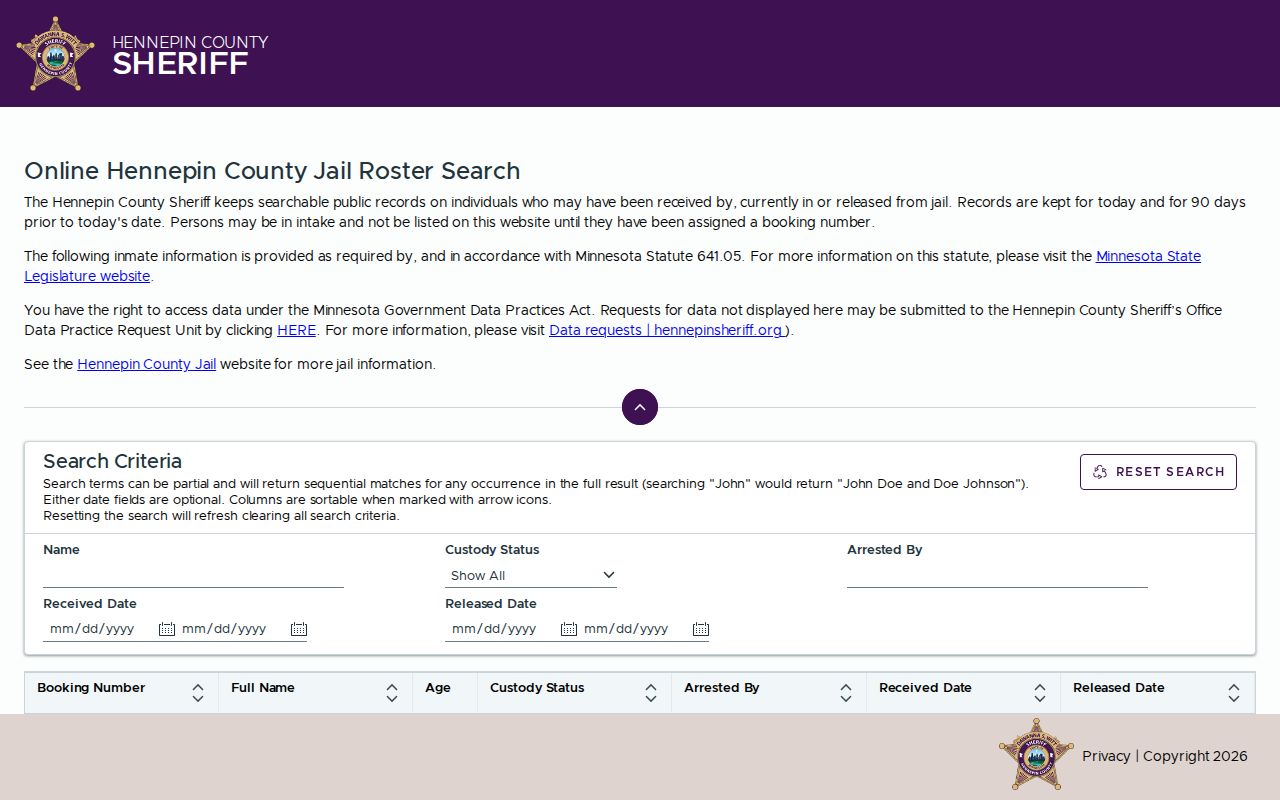
The captured interface shows the shared official source used for three-day and same-day release checks.
Hennepin Release Versus Transfer
“Released from Custody” means the HCSO booking ended. Community release is only one possible result. Cash bail or bond, court order, time served, and completion of a county term may lead outside custody. A transfer can instead place the person with Minnesota DOC, another county, the U.S. Marshals Service, or ICE.
| Observed result | Next check |
|---|---|
| Still in HCSO custody | Use the current roster record and jail information line. |
| Released with county case continuing | Compare Released Date/Time with MCRO bond and court events. |
| Possible state transfer | Search the Minnesota DOC Public Viewer for an incarcerated or release status. |
| Possible federal or ICE transfer | Use the federal docket, BOP or USMS route, or ICE locator as appropriate. |
A negative receiving-system result is not proof of community release. New records can lag, names can vary, and each locator has its own jurisdiction. Preserve the booking number and request the transfer recipient when the path remains unclear.
County and state systems also use different meanings for release. The Hennepin roster records the end of a Sheriff booking. The MNDOC Public Viewer can show an “Under … Release as of” date for a person who physically left prison but remains under DOC jurisdiction. Expiration Date is later and concerns the end of the sentence or jurisdiction. Do not move a DOC date onto a county booking or treat a county timestamp as a state-prison discharge.
Request Hennepin Release History
For a release outside the public seven-day view, use the HCSO data-request page. Identify the person, approximate booking dates, and booking number when known. Ask for the existing custody record fields showing admission, release date and time, legal basis, custody status, and any transfer recipient. Inspection is free. Copy charges may apply under the county policy and Minnesota law.
VINE is useful for live county-jail notifications, but it is not a durable history. Minnesota Haven handles state prison and DOC community-supervision notice. The Minnesota DOC Public Viewer applies to people committed to the Commissioner and still within DOC scope. A court record may explain the order or sentence. Using the right system avoids treating an expired roster entry as if no release record exists.
The request should seek records that already exist. Include the full name, approximate booking interval, and booking number when available. Ask for received and release timestamps, custody status, legal basis, and transfer recipient. HCSO is not required to create a new explanation or calculate a custom list. Narrow fields and dates also reduce the chance of a high copy estimate. If the agency withholds information, its data-request process says it will identify the legal classification.
Note: HCSO promises recent online visibility, not permanent web access; older Hennepin release facts belong in a focused official request.